Does a Transparency Flag Mean a GIF Has Transparent Pixels?
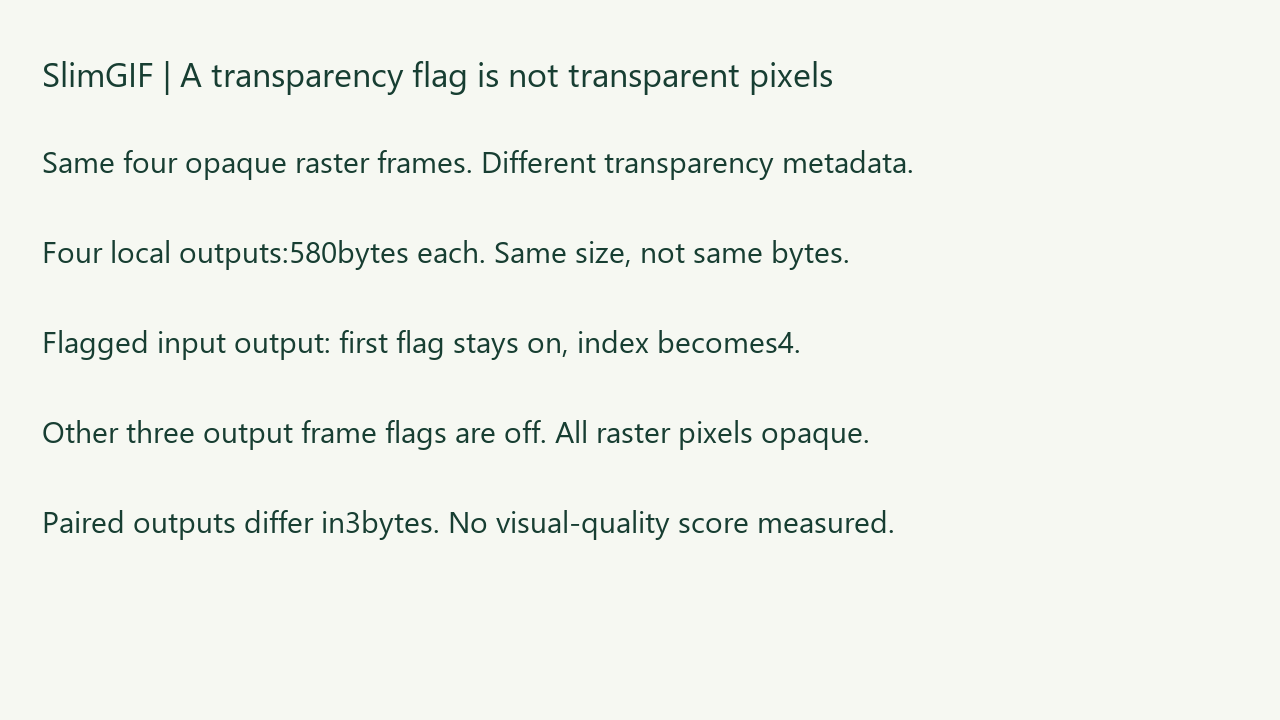
No. Our GIF can flag an unused palette index as transparent while every decoded pixel remains opaque. Two 1,913-byte inputs contain the same four opaque frames: one disables transparency, the other flags index 255 in each frame without using that index. Four local GIF compressor runs produce 580-byte files. Equal size does not mean identical bytes: the paired outputs differ at three offsets.
Measured November 4, 2026. Own CC0 synthetic files. These are local runs of SlimGIF's deployed engine, not observed website downloads. Saved files were decoded locally with Pillow and FFmpeg. Subjective visual quality and browser playback were not measured.
What we changed
Both inputs retain the same four 96 × 56 full frames, one 256-slot global palette, compressed image payloads, disposal 1, stored delays 100/150/200/250 ms and loop value 0. We change only four Graphic Control Extension transparency flags and their four index bytes. The visible raster uses four colors at indices 0–3. Index 255 is never used in the flagged source.
The GIF89a Graphic Control Extension definition, section 23 separates the flag from the index. Transparency affects a pixel when the relevant index is encountered during rendering; declaring an index alone does not show that a pixel uses it. This is format background, not an original discovery.
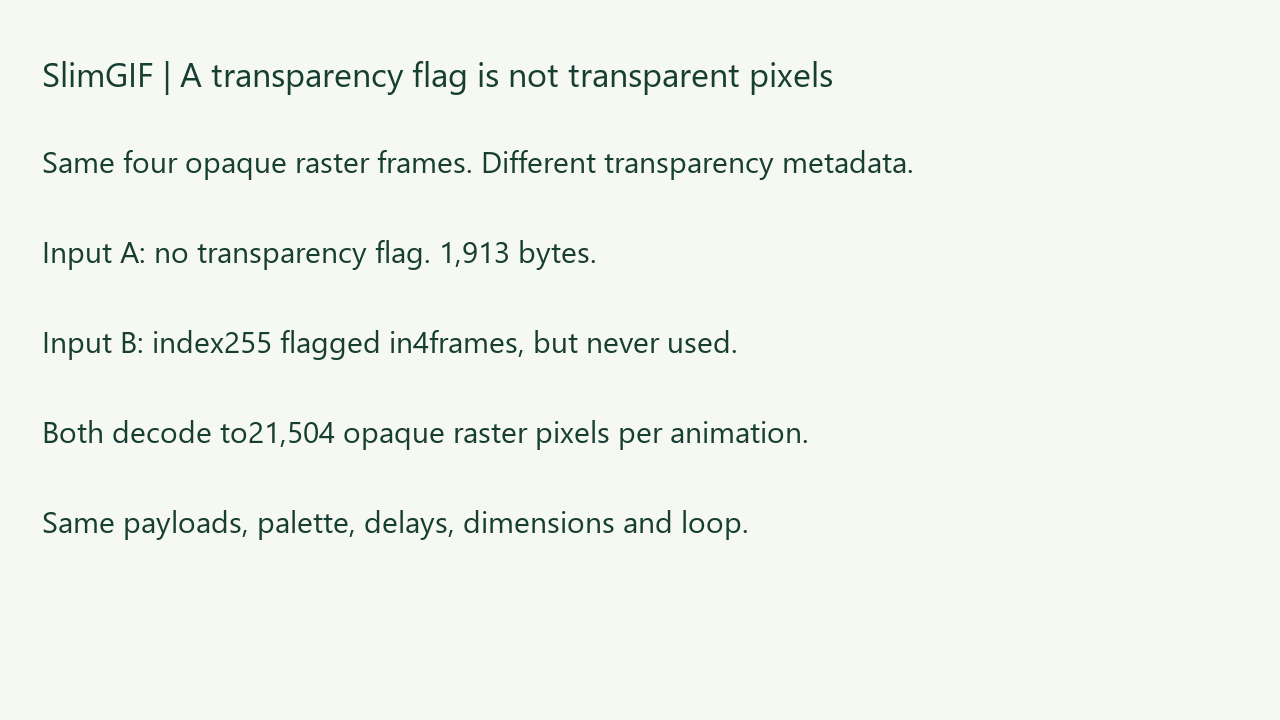
| Input | Input bytes | Lossless -O1 | Default -O1 /128colors /lossy30 | Input flags |
|---|---|---|---|---|
| Opaque control | 1,913 | 580 | 580 | All off |
| Unused index255 flagged | 1,913 | 580 | 580 | All four on |
What survived compression?
The flagged input's output keeps transparency enabled on its first stored frame, changes the transparent-index byte to 4 and turns transparency off on the other three frames. The unflagged control's output keeps all four flags off. All six saved files decode to the same complete RGBA frames; every frame has 5,376 pixels with alpha 255, or 21,504 opaque raster pixels across the four-frame animation.
There is another reason not to infer too much from one header value: the flagged output's first transparent-index byte is 4 while its global table contains four RGB entries (indices 0–3). That index is not used by a rendered source pixel in this fixture. We report the raw field and observed decoder result; we do not claim every decoder accepts or interprets this unused designation identically.
For each setting, the opaque and flagged outputs differ at exactly three byte offsets: logical background-index byte 11 (0 versus 255), first-frame packed control byte 47 (4 versus 5), and its transparency-index byte 50 (255 versus 4). Their lengths are equal at 580 bytes. Within each input, the lossless-setting and default-setting outputs are byte-identical.
Does clearing a flag save a byte?
Not by itself. The packed flag bit and index field remain part of the fixed-size control block in these files. Both inputs have equal size, as do both outputs. Do not attribute the 1,333-byte total reduction to the unused transparency setting: the engine also re-encodes data, reduces color tables and changes stored frame representation.
Is a transparent background missing?
A flag is insufficient evidence. Check composed pixels, their alpha values and the background where the animation will be displayed. Our pair deliberately starts with entirely opaque artwork, so it does not demonstrate removal of an actual transparent hole, semi-transparency, white halos or disposal trails. Those are different questions; see the disposal control and opaque-edge example.
Files and reproducible checks
Opaque input · Unused-transparent-index input · Opaque lossless output · Flagged lossless output · Opaque default output · Flagged default output


Hashes, raw GCE fields, changed offsets and local decode results · Commands and engine hashes · Fixture and verification source · Engine runner · Original source · CC0 and reproduction notes.

The input payload hashes match. Pillow and FFmpeg independently check complete raster frames; stored delays, dimensions and loop are checked locally. No current browser rendering, cross-browser compatibility, real-time playback or subjective-quality test is claimed. This is one small four-color case, not a promise for other files.
Current Google top-ten ranking and complete dynamic-page audit were not obtained. We claim this downloadable experiment, not worldwide or top-ten exclusivity. Keep your source and compare a saved GIF compressor result using multiple checks.
Watch the narrated experiment
Original figures, synthesized English narration. Complete transcript · Download MP4. Hosted on SlimGIF. Also watch the experiment on YouTube.