Do Unused GIF Palette Colors Change Compression Results?
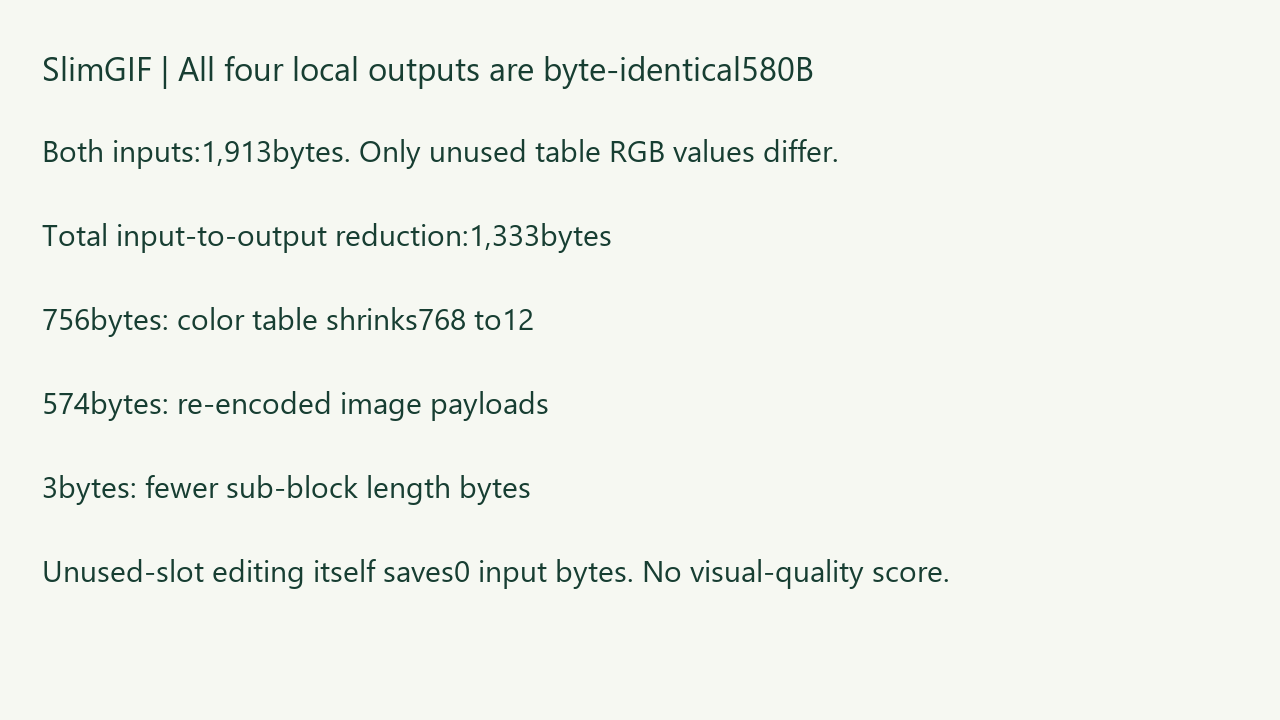
Not in our paired test: changing 252 unused RGB entries produced the same 580-byte compressed GIF. The two 1,913-byte inputs keep the same used colors, raster indices and compressed image data. Only unused palette values differ. Four local runs produce byte-identical outputs. Recoloring unused slots saves no input bytes; shrinking the table is a different operation.
Measured November 5, 2026. Own CC 0 synthetic files and figures. Local executions of SlimGIF's deployed engine, not observed website downloads. Saved-file frames were checked locally with Pillow and FFmpeg. Subjective visual quality, real-time playback and browser rendering were not measured.
Changing unused values without changing the animation
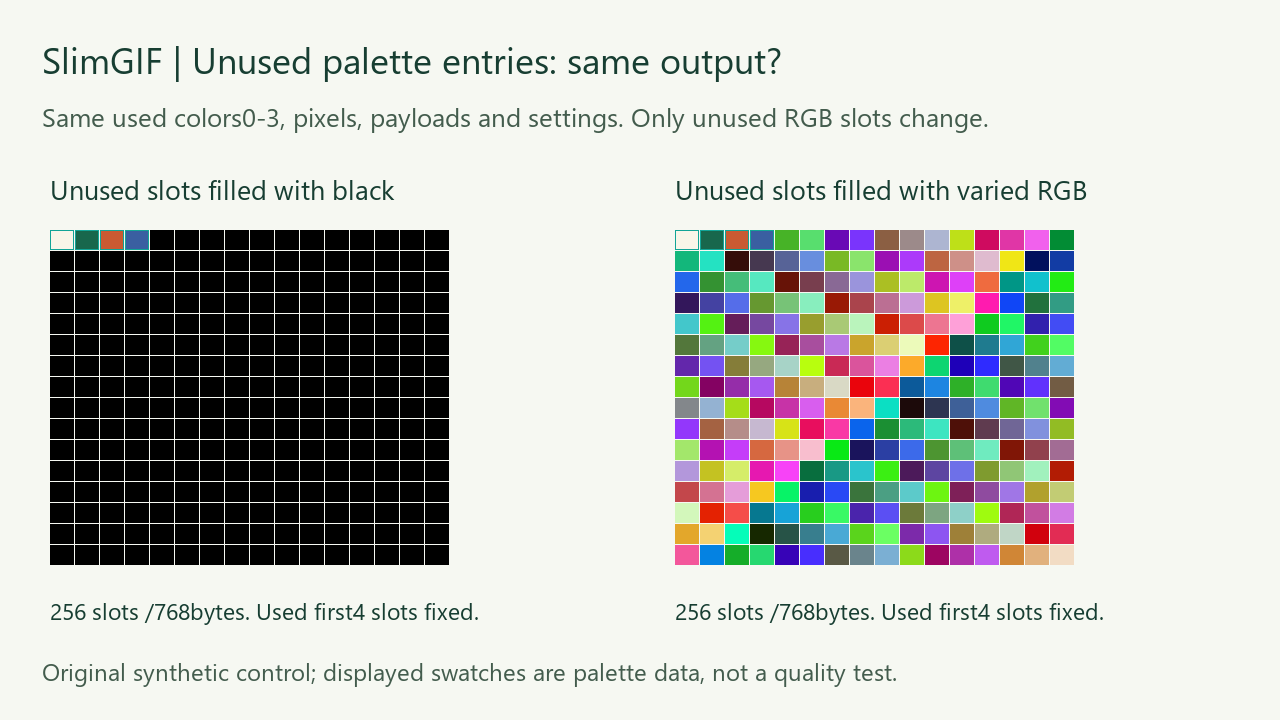
Each input has one 256-slot global palette occupying 768 bytes. The raster uses indices 0–3 in four full 96 ×56 frames. These first four RGB entries stay fixed. One input fills slots 4–255 with black; the other fills them with deterministic varied RGB values. There are 753 changed bytes, all confined to the unused portion of the table. All bytes after the global table match.
Frame order, compressed payloads, stored delays 100/150/200/250 ms, disposal 1, no transparency and loop value 0 are fixed. This is not the same experiment as renumbering used indices, sharing global versus repeated local palettes, or flagging an unused transparent index. Here only unused RGB values change.
| Unused entries | Input bytes | Lossless -O 1 | Default -O 1 /128 colors /lossy 30 |
|---|---|---|---|
| Black | 1,913 | 580 | 580 |
| Varied RGB | 1,913 | 580 | 580 |
What did the encoder retain?
All four output files are byte-identical. They retain one four-entry global table occupying 12 bytes, rather than the inputs'256-entry table. Pillow and FFmpeg independently decode all six saved GIFs to matching complete RGBA frames. Dimensions, stored delays and loop also match in the local checks.
For this input and engine, the unused RGB choices did not affect the final bytes. That does not prove that every encoder ignores every unused field, or that every palette entry can safely be deleted. An entry may be used by pixels, background information or transparency; a valid rewrite must handle references and coding correctly.
Where the 1,333-byte reduction comes from
The table contracts from 768 to 12 bytes, saving 756. Image-data payloads contract from 1,025 to 451 bytes, saving 574. Sub-block length bytes contract from 7 to 4, saving 3. Those reductions sum exactly to 1,333 bytes, the input-minus-output difference. The remaining fixed-length structure contributes no net length difference in this fixture.
These are structural byte-accounting categories, not independent switches or a causal estimate for each optimizer stage. In particular, deleting unused palette capacity explains only 756 bytes of the net length difference, not the entire 1,333. The re-encoded frame payloads and framing changed too.
Will painting unused slots black make a GIF smaller?
No size reduction occurs merely from replacing one three-byte RGB entry with another while keeping the same table capacity. Both controls remain 1,913 bytes. Our compressor re-encodes the file and reduces the table capacity; it does not just paint unused entries black. Keep the source and compare actual saved outputs.
Can I simply remove the unused bytes?
Do not delete arbitrary binary bytes. The table-size field, references and subsequent data boundaries must remain consistent. The GIF89a specification, Global Color Table section 19, defines a power-of-two table length. This format definition is background knowledge, not an original finding. An encoder should produce a coherent table and image stream.
Reproduce this control
Black-unused input · Varied-unused input · Black lossless output · Varied lossless output · Black default output · Varied default output


Six-file hashes, frame hashes, changed offsets and byte accounting · Commands and engine hash · Fixture and verification source · Engine runner · Original source · CC 0 and reproduction notes.

This tiny four-color control is not a general performance prediction. Current Google top-ten dynamic bodies and fresh official keyword values were not obtained, so no top-ten or worldwide exclusivity is claimed. Matching raster frames are file-level evidence, not a measured subjective-quality score. Try the GIF compressor with your original and inspect the saved animation.
Watch the narrated experiment
Original figures, synthesized English narration. Complete transcript · Download MP4. Hosted on SlimGIF. Also watch the experiment on YouTube.
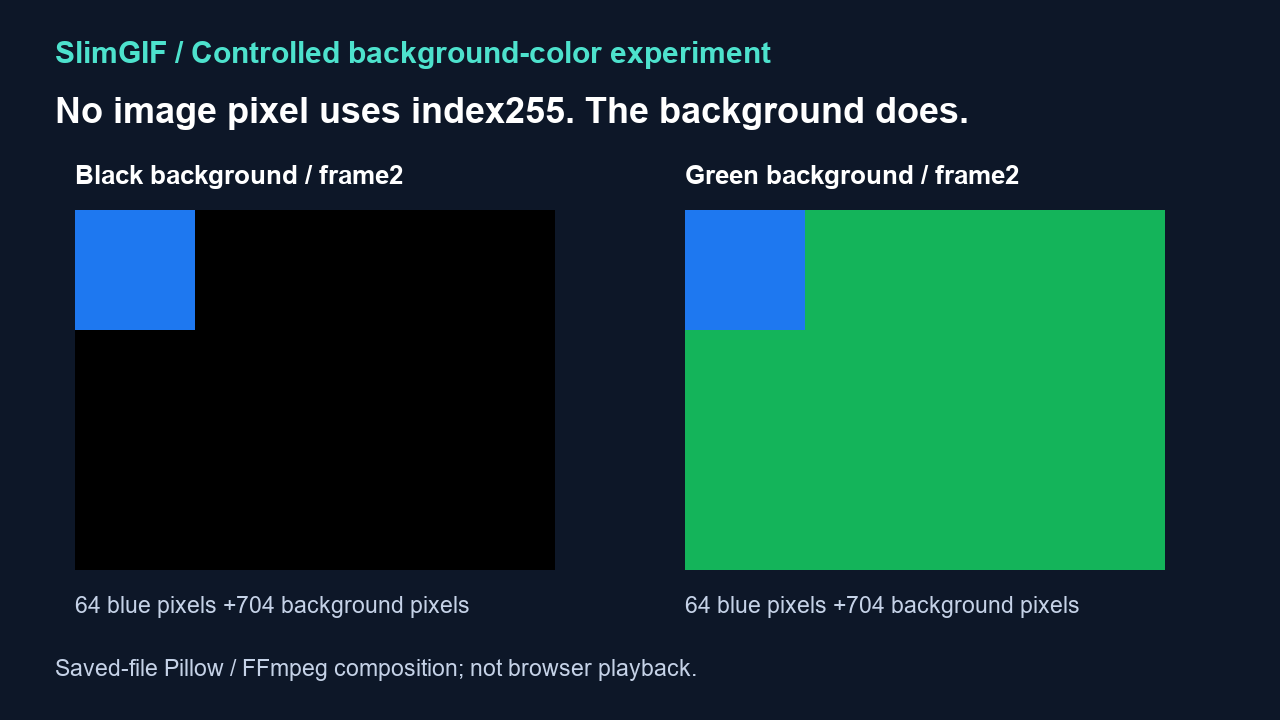
A color absent from image indices may still be referenced by the background. See the three-byte background control and complete-frame checks.