Can You Remove a GIF Palette Color That No Image Pixel Uses?
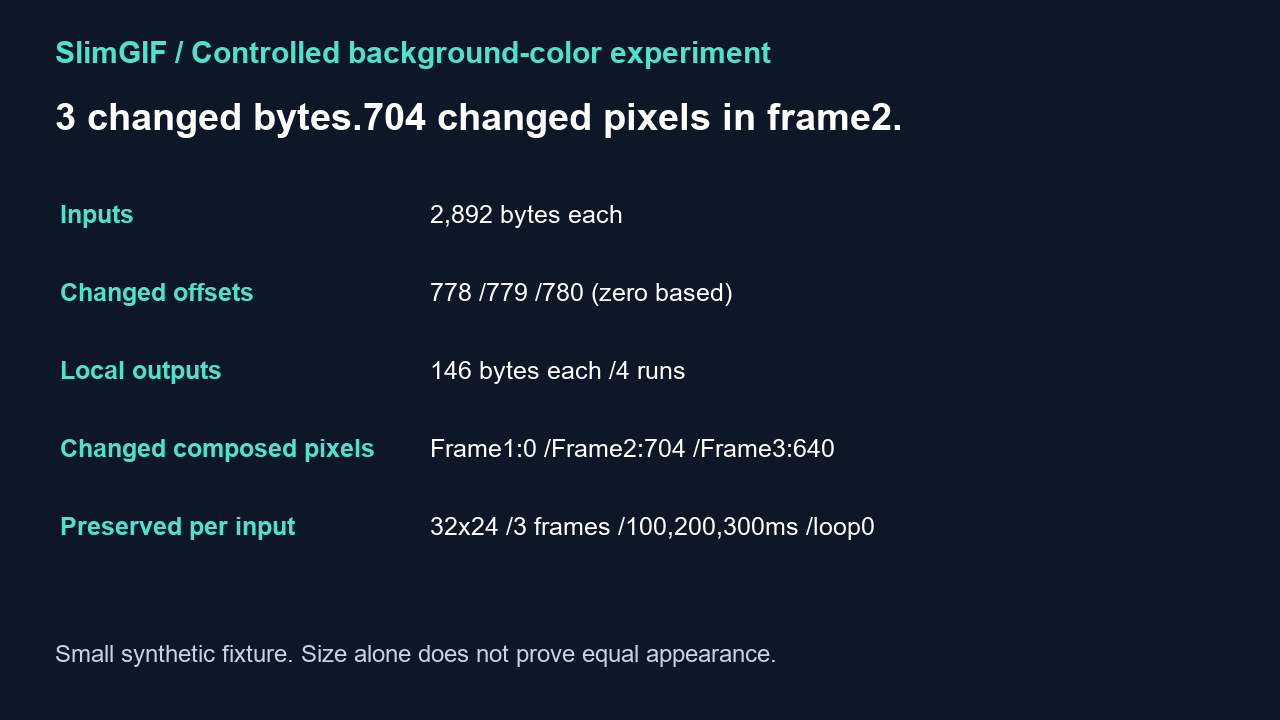
Not if the background still references it. In our controlled pair, image pixels use only indices 0, 1 and 2, but the logical background uses index 255. Changing just that slot's three RGB bytes changes 704 pixels in the second composed frame. Both inputs are 2,892 bytes. Four local compression runs return 146-byte files, each retaining its own background.
Measured November 6, 2026. Original CC0 synthetic files and figures. Local executions of SlimGIF's deployed engine, not observed website downloads. We decoded complete saved-file frames locally with Pillow and FFmpeg. Subjective quality and actual browser animation playback were not measured.
What changes when only a background-referenced slot changes?
Both inputs have a 32 × 24 canvas, a 256-slot global color table and three image rectangles. The background index is 255 in both. One table stores black at that slot; the other stores RGB (20, 180, 90). Exactly three bytes differ: zero-based offsets 778, 779 and 780. Every byte before and after those three, including all compressed image payloads, is identical. There are no enabled transparency flags.
Frame 1 paints the full canvas red and uses disposal 2. Frame 2 paints an 8 × 8 blue square at (0, 0), and frame 3 adds an 8 × 8 yellow square at (24, 16); both use disposal 1. Stored delays are 100/200/300 ms, with loop value 0. The source generator writes only raster indices 0, 1 and 2. Index 255 is absent from image pixels but is still referenced by the logical screen background.
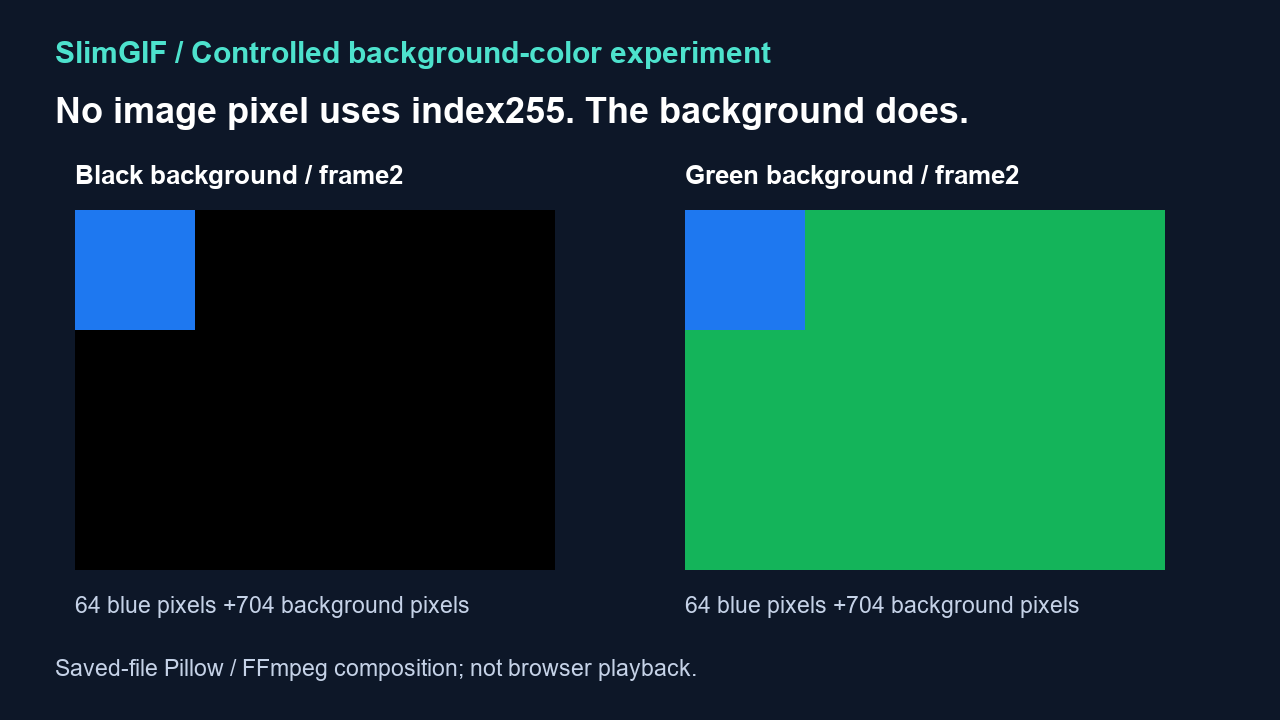
| Background slot 255 | Input bytes | Lossless -O1 bytes | Default bytes | Frame 2 background pixels |
|---|---|---|---|---|
| Black (0, 0, 0) | 2,892 | 146 | 146 | 704 black +64 blue |
| Green (20, 180, 90) | 2,892 | 146 | 146 | 704 green +64 blue |
Why does an index outside the image pixels matter?
The GIF89a specification defines a logical background reference into the global table and a disposal operation that restores a frame's area to that background. Those definitions are established format behavior, not a new discovery. In our no-transparency fixture, disposing the full first frame exposes the selected background before the next small rectangle is painted.
The paired inputs have identical first composed frames. Across the complete 768-pixel canvas, frame 2 differs at 704 pixels and frame 3 differs at 640. At coordinate (16, 12), frame 2 is RGBA (0, 0, 0, 255) versus (20, 180, 90, 255). Counting only which indices occur in compressed image data would miss this dependency.
Did compression preserve the referenced color?
For each input, the local lossless command was -O1 input.gif -o /out/output.gif. The local default command was -O1 --colors 128 --lossy=30 input.gif -o /out/output.gif. All four outputs are 146 bytes, but the black and green variants are different files with different composed pixels. Each output's complete RGBA frames match its corresponding input in both tested decoders; dimensions, stored delays, frame count and loop value also match. These checks describe the saved input/output files decoded locally, not every possible player.
Can I safely delete that slot to make the GIF smaller?
Do not delete arbitrary table bytes. A coherent rewrite must keep table-size fields, raster indices, background references and any transparency references consistent. A slot can be absent from image pixels and still matter elsewhere. This is a different intent from our fixed-index test of truly unused RGB values and our transparent-frame trail comparison: here the disposal setting never changes, and the inputs have no transparent pixels.
The generated source resets LZW before every literal to simplify auditing. It is intentionally inefficient, so its compression ratio is not a typical encoder benchmark. This three-frame control does not establish a universal result for transparent GIFs, local palettes, other disposal methods or device firmware. Preserve your source and compare a saved output with the corresponding input.
What question does this answer?
Can a background change even when the changed color never occurs in image pixels? Yes in this specific paired fixture, because the background field references it. A Pillow user's disposal-2 report is a separate real example of why composed backgrounds need care. Our fixtures do not reproduce that issue or diagnose its cause; that discussion is context, not evidence for our measured counts.
Download the controls and verify the result
- Black: input, lossless output, default output.
- Green: input, lossless output, default output.
- File hashes, full-frame hashes, decoder versions and pixel counts · Exact local commands and engine hash · Source and verification · Local engine runner · CC0 and reproduction notes.


Google's English US-parameter Web results were recorded on November 6, 2026. The ten returned URLs were archived over HTTP, and EZGIF's visible text was also reviewed. Their palette, static-region and transparency explanations are prior art. Full dynamic-page review remains incomplete, so this page makes no claim that all ten lack an equivalent example. Our evidence contribution is the linked paired files, exact changed offsets and independently decoded counts above.
Open the GIF compressor. Keep the original and check the saved animation after changing settings.
Watch the narrated experiment
Original figures, synthesized English narration. Complete transcript · Download MP4. Hosted on SlimGIF. Also watch on YouTube.