Can LZW Minimum Code Size Change a GIF's File Size?
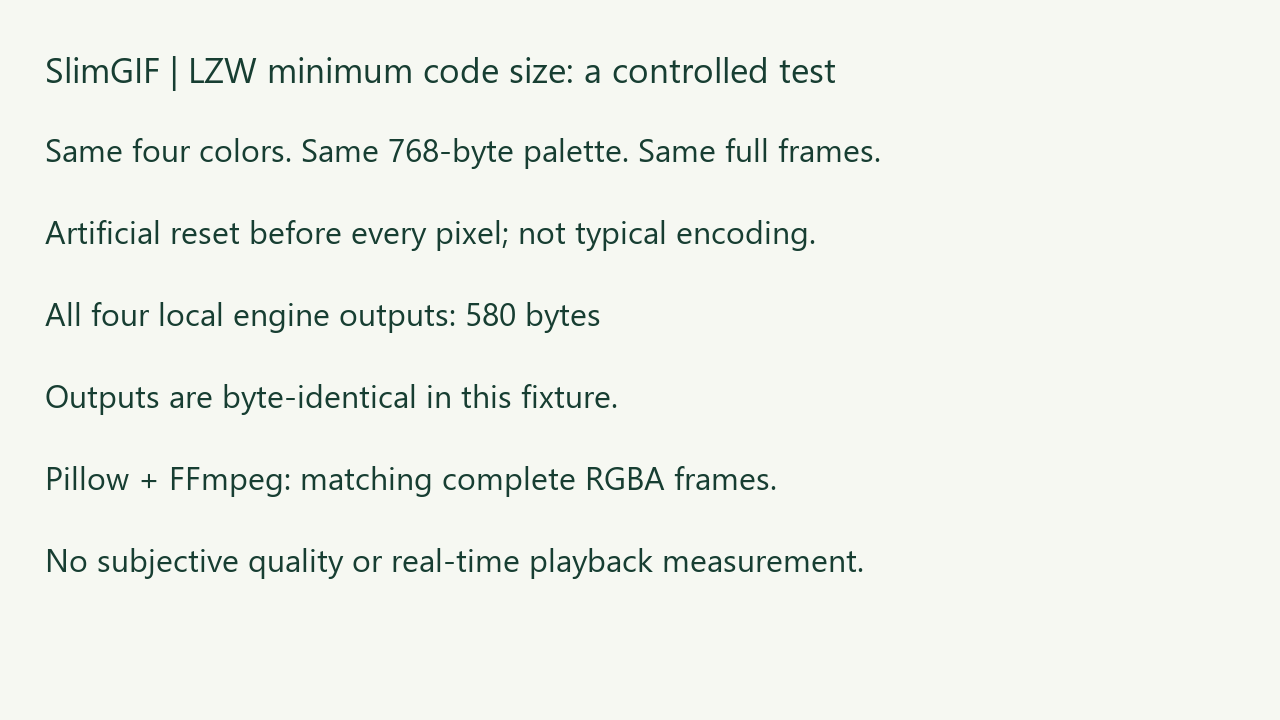
Yes, in this controlled coding example: the same four-color animation uses 17,077 bytes at minimum code size 2 and 49,465 bytes at 8. Both keep the same 768-byte global palette. We deliberately reset the dictionary before every pixel, making both files inefficient; this is a mechanism demonstration, not a typical compression benchmark. Four local GIF compressor runs re-encoded them to byte-identical 580-byte outputs.
Measured October 31, 2026. Original CC0 synthetic files and figures. These are local executions of SlimGIF's deployed engine, not observed website downloads. Saved files were decoded locally with Pillow and FFmpeg. Subjective visual quality and real-time browser playback were not measured.
What stays fixed, and what changes?
Both inputs use exactly the same four RGB colors at indices 0–3, one 256-slot global color table (768 bytes), four full 96 × 56 frames, stored delays 100/150/200/250 ms, disposal 1, no transparency and loop value 0. The composed RGBA frames match. The difference is how we encode their image data: LZW minimum code size 2 versus 8.
For a narrow control, our encoder emits a Clear code before every literal pixel, then an End code after the last pixel. The semantic reset/literal schedule is identical; the Clear and End code values and packed bit widths change. No dictionary patterns are reused. Initial widths are 3 and 9 bits respectively. This deliberately wasteful construction isolates code-width overhead; ordinary encoders learn repeated sequences and do not reset this often.
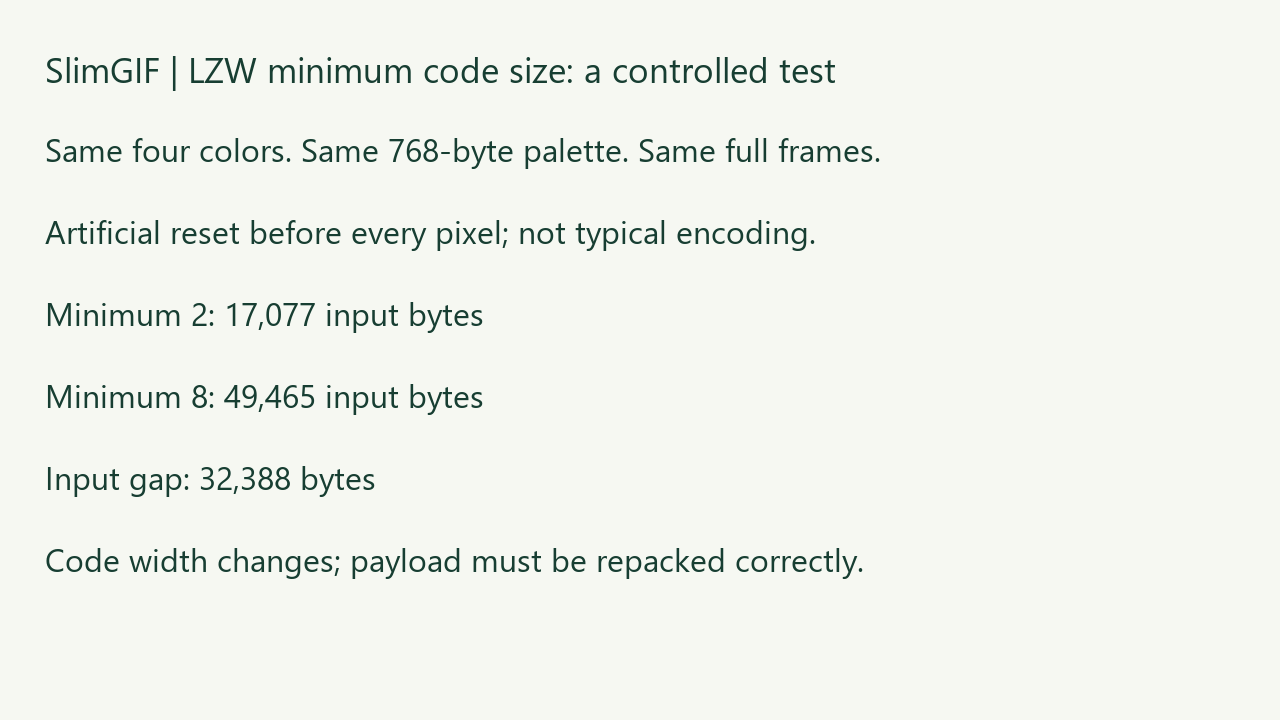
| Input minimum | Input bytes | Lossless -O1 | Default -O1, 128 colors, lossy 30 |
|---|---|---|---|
| 2 | 17,077 | 580 | 580 |
| 8 | 49,465 | 580 | 580 |
Where the 32,388-byte input gap comes from
Each frame contains 5,376 pixels and 10,753 codes: 5,376 Clear/literal pairs and one End code. At 3 bits per code the packed payload occupies 4,033 bytes per frame; at 9 bits it occupies 12,098. Across four frames that adds 32,260 payload bytes. Grouping into sub-blocks of at most 255 bytes adds another 128 length bytes: 64 length bytes versus 192. The total difference is exactly 32,388 bytes. Every other container field is fixed.
This differs from renaming palette indices, which saved zero bytes in our fixed-minimum test, and from sharing repeated color tables. Here we retain the same table capacity and used colors, while changing and repacking image-data codes.
What the compressor results do and do not prove
Two settings per input produced four byte-identical 580-byte files. The engine can rebuild the inefficient stream; its total saving also includes table reduction and frame representation changes. Do not attribute all input-to-output savings to the initial minimum code size. This tiny four-color fixture does not predict savings for photographs, textured motion, other encoders or already optimized files.
Can I just change that one byte?
No. It determines dictionary initialization, reserved codes and initial packed width. Our pair rewrites the payload and Clear/End values together. Editing the minimum byte alone can leave a stream that a decoder cannot interpret correctly. Keep the original and use an encoder that rebuilds valid image data.
Does a 256-slot table force every image to use minimum 8?
Our paired files retain 256 table slots while only indices 0–3 occur in image data. Pillow and FFmpeg decode both to matching complete frames. That is a result for these files and those decoders, not a promise about every application. A palette's capacity, its actually used entries and LZW's coding state are separate things.
Files, method and limitations
Minimum-2 input · Minimum-8 input · Minimum-2 lossless · Minimum-8 lossless · Minimum-2 default · Minimum-8 default


File hashes, frame hashes, timing and raw structure · Commands and deployed-engine hash · Fixture and verification source · Original four-color source · Local engine runner · CC0 and reproduction notes.

The GIF89a specification, Appendix F, defines minimum code size, Clear/End codes and bit packing. These definitions are background explanation, not an original discovery. Our contribution is the downloadable controlled pair and measured byte accounting. Dynamic search-result bodies were not fully audited, so we make no claim of worldwide or top-ten exclusivity.
For practical use, keep the original, try a GIF compressor baseline and compare the saved animation. This experiment does not require manually editing binary data or guarantee that changing a minimum will improve an existing GIF.
Watch the narrated experiment
Original synthetic figures with synthesized English narration. Read the complete transcript or download the video. Hosted on SlimGIF; playback starts only when you choose. Local file checks and limitations are described above.